Finding What Was Lost
On isolation, the longing for the collective, and the birth of Mother’s Hollow

Back in the fall of last year, I set off on a journey to find myself. I was to spend a week unattached—to children, to work, to caregiving—a week of release from the trappings of my daily life. In the fifteen and a half years since I had become a mother, I could count on one hand the number of times I had spent time away, and never in that time had the focus been solely on myself. It was time.
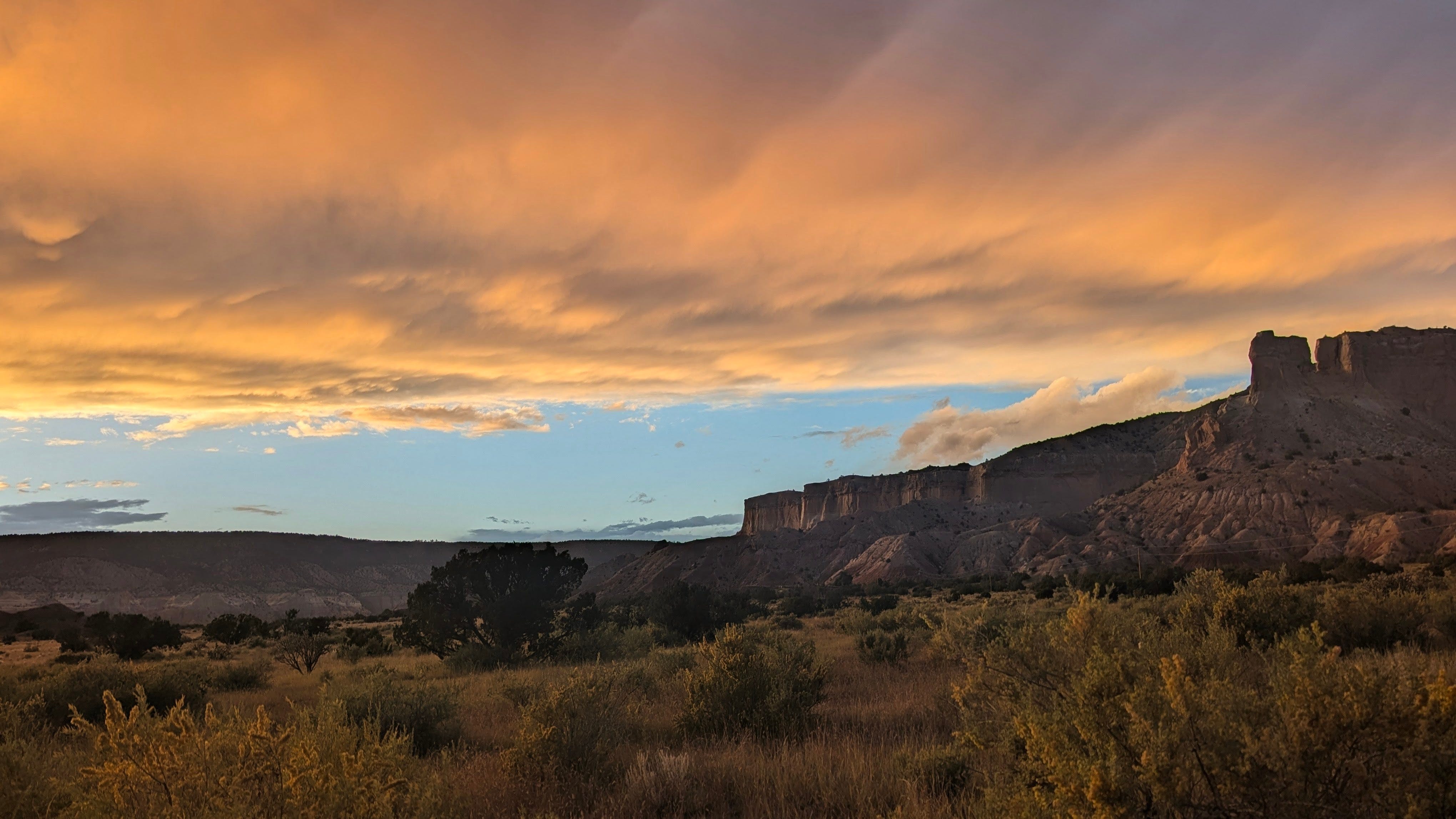
Through a series of improbable consequences (some might call them synchronicities), I found myself one October day taking a seat on a plane and heading to a remote retreat center in northern New Mexico. Famous as the desert home of artist Georgia O’Keeffe, Ghost Ranch is now a hub for seekers. Offering classes and workshops ranging from metalsmithing to weaving, from yoga to plein-air painting, Ghost Ranch is a place many come to find a lost piece of themselves. As I settled into my seat on the plane, I was departing the moss-laden, rain-soaked forests of the Pacific Northwest for the rocky, sun-drenched vistas of the Southwest. The dramatic contrast between the two environments was not lost on me—I was leaving a place where hiding among trees was possible for one in which exposure was guaranteed. In seeking exposure, I hoped to recover a piece of myself I had not realized I had ever lost until recently.
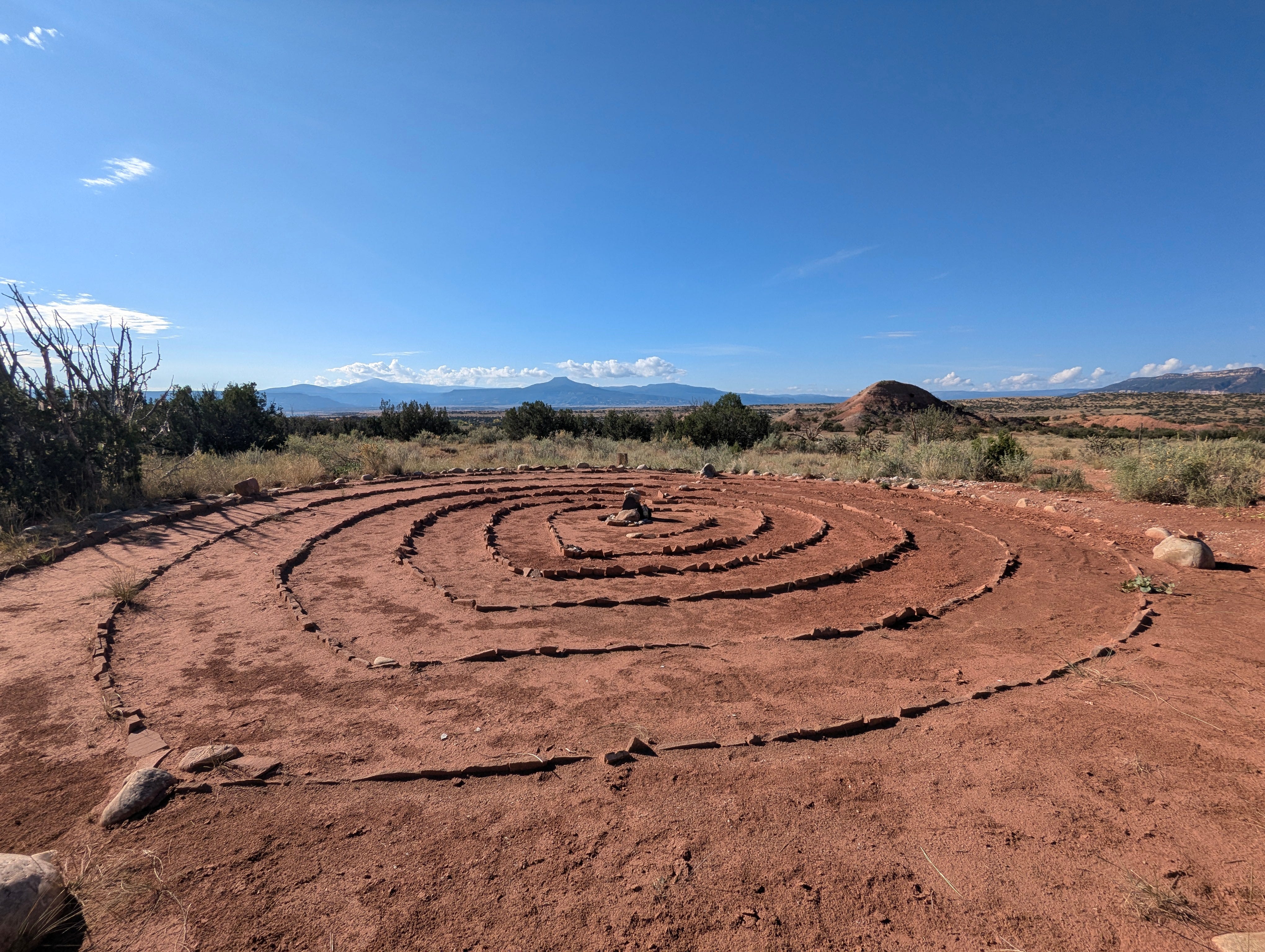
The event that drew me to Ghost Ranch for that week was a women’s retreat focused on “soul tending in times of uncertainty.” It was, for me, not only a chance to tend to my exhausted, grieving soul but also a chance to breathe life into a faint flame I had felt flickering to life within me. A new awakening. It has now been six months since my week at Ghost Ranch, and I am still finding my way along the path this experience opened for me. Each time I return, in my head and heart, to this place, blanketed with sagebrush and the light of a full Harvest Moon, I remember the feeling of complete alignment and aliveness I experienced. Even now, I recall the gentle breeze that stirred around me as I sat on a patch of dry earth, holding a white, sand-crusted pebble in my hand and gazing admiringly at a Canyon Towhee as he flitted about. As I took in the sounds, sensations, smells, and vibrations of the earth, I also began to hear my own voice, long drowned out by the crushing noise of responsibility, caregiving, anxiety, and duty.
But it was not just these delicious moments of being alone with myself that touched me so deeply; it was also the opportunities to come together with other women—across a spectrum of ages and life experiences—that helped pull me into a new vision of myself and my place in the world.
Over the course of the week, our small band of women gathered each morning to talk, to learn, and, on many occasions, to be deeply witnessed in our becoming. No matter our age, as we gathered—from maiden to mother to crone—we were all on a journey. We all had griefs that had shaped us, hardships that had worn crevices in our hearts, and memories of being cherished that continued to lead us forward. It was in these small group gatherings, connected to women I had never met before and probably would never see again, that a quote from one of my favorite authors echoed through my mind,
“It is through the collective that healing begins” –Asia Suler
It was in those circles that I began to understand what had been missing—not just for me, but for so many mothers. Asia’s statement is such a simple and profound one, I think, when we apply it to modern motherhood. What healing, one might ask? Or perhaps, upon reading this, one might sense that a “collective” sounds appealing, but hardly part of our existence. How does one ever experience, in our daily, overwhelmed lives, a sense of belonging with others that creates space for healing?
As I reflect on my early mothering journey, one word hangs over the many days and nights: “isolation.” Isolation lurked daily in the early postpartum days, when time became a strange beast, both flying away and dragging unbearably slowly. Days and nights bled into one another, and I wondered how I would ever have the strength to make it through another feeding, another sleepless night, another cry for need and care. I loved each of my babies dearly, and it was this unimaginably deep devotion to them that gave me the strength to do the next thing that needed doing, but inside, I felt utterly alone in this doing. Yes, I was incredibly lucky to have a devoted and caring partner who would do anything he could to help our child and me, but what I needed was a tribe of women who understood—a gathering of women who could pass on wisdom and offer reassurance. But for me and so many women who become mothers today, the tribe is not there. We find ourselves trapped behind locked front doors, hidden in bedrooms and nurseries, separated from kin by distances both literal and figurative, and distanced from other women by impossible-to-cross chasms created by a society that tells us we should be able to figure this out on our own. We should be able to mother on our own. And so, we stay hidden and isolated, not realizing, or perhaps not willing to admit, the hurt our souls are enduring. It is easier to pretend everything is going well than to admit a deep wounding has occurred.
In the literature on early motherhood, access to “social support” is an important predictor of maternal well-being (Barrass et al., 2025). In psychological research, social support refers to the presence of social networks, including friends, family, partners, medical providers, and community groups. In the maternal health literature, social support has been found to buffer the effects of stress both during pregnancy (Bedaso, Adams, Peng, & Sibbritt, 2021; Biaggi, Conroy, Pawlby, & Pariante, 2015) and during early motherhood (Pulsipher & Dufur, 2026). Social support has been measured with a range of survey instruments, including the Multidimensional Scale of Perceived Social Support (MOSS, Zimet et al., 1988), which asks respondents to rate their agreement with statements such as “there is a special person who is around when I am in need”; “I have friends with whom I can share my joys and sorrows”; and “my family is willing to help me make decisions.” But looking at these items, I wonder whether they truly tap into the deeper need for connection that many mothers feel. I would likely have agreed with all of these items as a new mother, yet something was still lacking. I wonder whether, if I had been asked something like the following, whether the deep hole left by a society that leaves mothers alone and isolated would have been touched:
I am witnessed among women who see the real me.
I can speak of my needs, wants, fears, and cares and am heard.
I have female companions who tell me stories of old that help me see my place in the world and link me to mothers who came before me.
Or perhaps,
I have a circle of women who hold me when I have no energy to lift my head.
If we measured “social support” in this way, I wonder what we would find? I feel certain this is what Asia Suler meant when she spoke of “the collective.” While surface-level social support may help some address the daily hassles of mothering, it will do little to reach the voice within her that yearns for something deeper. As I discovered on my journey to Ghost Ranch, only through deeper connections with a circle of women who are present to witness, encourage, hold, and uplift can the inner self’s deeply wounded pieces begin to heal. This is the healing our mothers so desperately need today. Access to hands-on, practical help is absolutely necessary, of course. Women do need support in learning the tasks of motherhood they have never been taught — such as how to feed, how to comfort a sick child, and how to understand the meaning of a child’s cries — but none of this reaches the mothers’ deeper emotional plane. Hidden, perhaps even from her own awareness, this inner space is where doubt lingers, cries for help erupt but are abruptly silenced, and feelings of insurmountable aloneness threaten to topple her highly functioning façade. Ancient cultures once understood the need to carry women collectively over the threshold of motherhood with care, compassion, and respect, but much of that knowledge has been lost or forgotten. It is time to bring it back. Our mothers need it.
Over the past several months, in the wake of this experience, something new has been growing in my imagination and slowly taking shape in my life. I’m calling it Mother’s Hollow, and it is a place to return to the soul of motherhood. Mother’s Hollow is a space for mothers to be witnessed, held, and accompanied in the inner journey of becoming a mother. Informed by both my lived experience as a mother of four and my expertise in maternal and child psychology, Mother’s Hollow is a place for mothers to gather meaningfully, grow, and be witnessed. It will take shape through small circles and classes, and one-on-one conversations—spaces where mothers can come as they are and be met there. Mother’s Hollow is new and growing slowly. If you are interested in learning more, please come explore the Hollow at www.mothers-hollow.com. I would love to welcome you there.